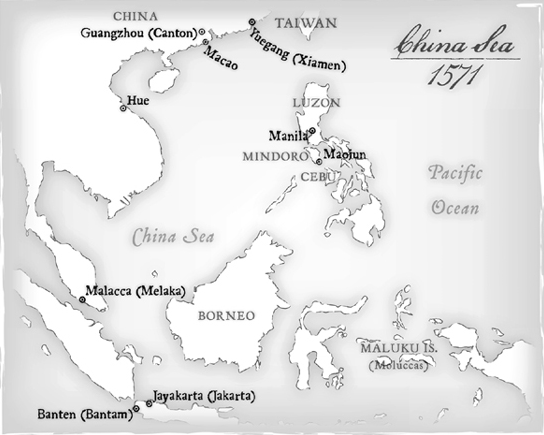
For most of the 1500s, silver was worth roughly twice as much in China as in Europe. There was nothing mysterious about why. China's paper currency had collapsed, and by the 1570s the Ming government was collecting more than 90 percent of its tax revenue in raw silver. A country of well over a hundred million people had been ordered to pay in a metal it barely produced. Inside China, an ounce of gold traded for about six ounces of silver. In Spain that same ounce of gold cost you twelve or more. This was one of the largest arbitrages in the world and it sat in the open for a century. The Spanish found the silver mountain at Potosí in 1545. Then, they took Manila in 1571. After that, galleons carried silver west from Acapulco and came back loaded with silk and porcelain. Somewhere between a third and half of all the silver mined in the Americas ended up in China.
The trade closed the gap, the way trades do. By the 1640s silver prices had converged worldwide, and a million pesos bought about a third of what it had a century earlier. Ming taxes were fixed in weights of silver rather than in value, so as silver fell the government's real revenue fell with it. They could not pay their armies. Subsequently, the dynasty fell in 1644.
Every participant understood his own transaction perfectly well. The miner at Potosí knew the price of ore. The captain out of Acapulco knew his freight costs and his odds of drowning. The tax collector in Fujian knew what his district owed that year. None of them could see that they were links in a single loop three continents wide, or that the loop was consuming the very spread that drove it. The information that would have mattered was not hidden by anyone. Rather, it was spread so thin across that nobody stood in a place where it could be read.
Complex systems constantly create situations like this. They scatter information so unevenly that no one person holds enough of it to act on, which creates an edge that belongs to whoever is willing to go collect the pieces and put them together. I’ll be dedicating this blog to researching the markets to find this edge and capture it, and, ultimately, I’ll be providing you, my readers, with this edge.
(The story is told well in Charles C. Mann's 1493; the ratio figures come from Dennis Flynn and Arturo Giráldez, whose work Mann draws on.)